
Education and training at the Infantry School – consideration of lessons learned relating to the war in Ukraine and alliances
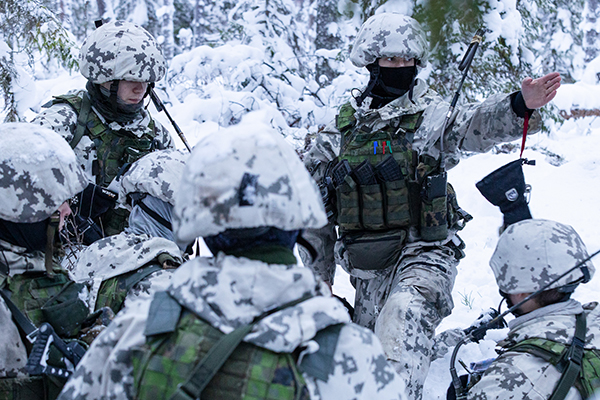
The Infantry School (INFS) trains non-commissioned officers (NCOs) on a number of levels, as well as Army cadets on the Army programme and infantry branch studies. Additionally, on a yearly basis, infantry students on the Master of Military Sciences programme are trained at the INFS. The NCO training provided progresses from the basic-level tri-service OR-5 studies to relating infantry branch studies, to advanced-level tri-service OR-7 studies, to senior-level tri-service OR-9 studies. Additionally, the INFS holds the executive responsibility for a high number of continuing professional development training events for the infantry.
The INFS provides education and training in infantry branch studies including the following infantry training specialisations:
- jaeger
- mortar
- reconnaissance and intelligence
- military police
- anti-armour and anti-tank.
Moreover, weapon and marksmanship training are key in all INFS activity.
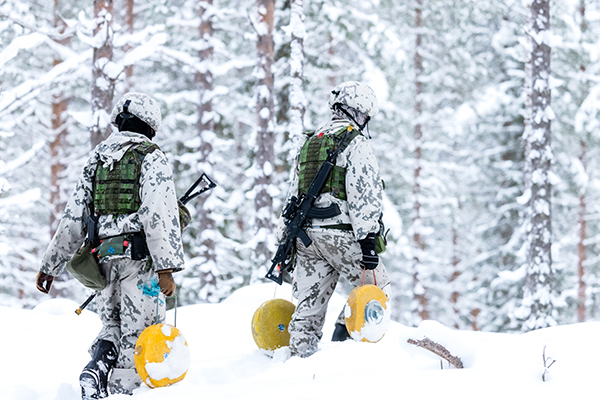
At the INFS, education and training focus on learning by doing. It takes more than lectures or map overlay rehearsals to learn combat TTPs and tactical use of forces albeit both do have their set place on the curricula. As well as honing new skills, NCOs and cadets are also trained in instructing competence.
What are top priorities in education and training at present? How are lessons learned concerning Ukraine considered?
To narrow down the scope of this text, the following discusses, on a general level, the basic-level tri-service OR-5 studies, as well as cadet training. First, on the basic-level tri-service OR-5 studies. Observations from Ukraine demonstrate that survival on the battlefield is dependent on thorough knowledge of Soldier’s skills. On the basic-level tri-service OR-5 studies, the training priority specifically focuses on the Soldier’s skills.
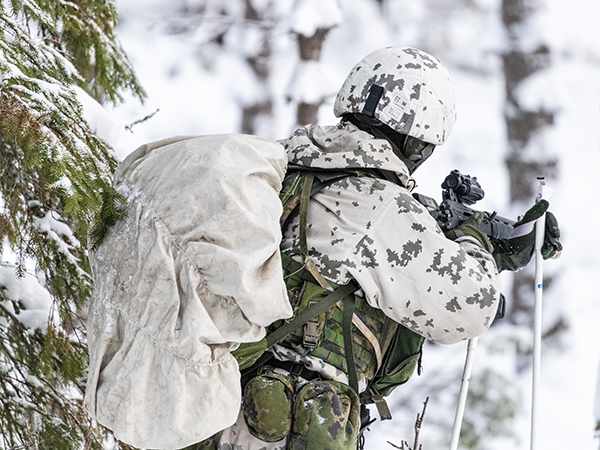
The basic competence requirement for a Soldier, these skills include:
- shooting skills
- weapon handling skills
- mastery of equipment and combat TTPs
- conditions training
- in-service and occupational safety
- instructing competence
- physical performance capability.
The basic-level tri-service OR-5 training focuses on learning combatant-specific skills and honing instructing competence as well as thorough knowledge of section-level combat TTPs.
Observations from Ukraine demonstrate that survival on the battlefield is dependent on thorough knowledge of Soldier’s skills.
During the tri-service OR-5 studies, training exercises underline drone threat, operating in fortified positions, TC3, weapon and marksmanship training, as well as physical performance capability. These are also key findings from Ukraine on battlefield success. Furthermore, training also strongly underlines battlefield transparency. The aim is to assess at all times the impact of varied conditions on own operating. The ability to adjust in changing situations plays a key role already in basic training.
As the operating environment and conditions in Finland differ significantly from those in Ukraine, training strongly considers our national Finnish circumstances that need to continue to be viewed as our opportunity and advantage. Held in ”basic Finnish terrain”, training exercises are also conducted under more demanding conditions in Northern Finland. This reinforces students’ competence in operating under demanding and varied conditions, and also allows testing and exercising individual Soldiers’ physical performance capability. The closing phase of the tri-service OR-5 studies includes a competence demonstration on Soldier’s skills to verify graduates’ competence. On the one hand, the competence demonstration verifies students’ aptitude for the branch-specific studies, and, on the other hand, their competence in implementing these skills while instructing conscripts at the given brigade-level units.
Having completed the tri-service OR-5 studies, infantry NCOs complete branch-specific combat arms studies in accordance with their set infantry training specialisation at Lappeenranta. The objective of the branch-specific studies is to acquire basic competence concerning equipment and combat TTPs of different training specialisations, and to expand competence in, for instance, weapon and marksmanship training. During branch-specific training, physical strain will increase progressively, and mental resilience is put to the test on purpose. This translates into students being tested in physically demanding fast marches and exercises. The branch-specific studies also shift the focus more on leadership, and thereby managing initiative-taking and activity. A significant observation from the battlefields in Ukraine is that leaders must be capable of executing independent solutions as part of the battleplan of a platoon, company, or battalion.
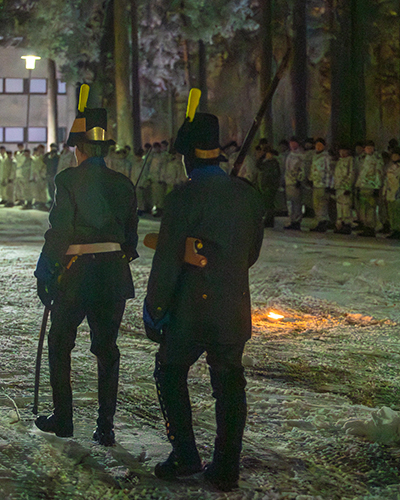
In looking at training provided for cadets, the same abovementioned contents apply, although studying will progress from soldier- and section-level operating to the platoon- and company-level. On the Army programme, cadets arrive at the Army Academy with the Soldier’s skills instructed at the National Defence University. These skills are strengthened at Lappeenranta during the spring term with the training focus swiftly shifting to platoon-level tactics and combat TTPs, focusing more on the use of forces as a whole. Infantry cadets will later during the Bachelor of Military Sciences studies undertake training in company tactics and equivalent-level employment of weapons and equipment of infantry training specialisations.
At the INFS we assume, for instance, that the fundamentals of combat TTPs of a platoon and company must be mastered also in the future but with the ability to adapt and adjust these. While advancing from the combat technical level to the use of forces, we face wider issues: How do we use forces to attack and defeat fortified adversary positions? How do we execute CUAS activity? How do we employ drones and UAS to deliver effects? What types of opportunities does new technology make available for forces? How do we enable taking initiative? How do we protect the use of forces while countering the air threat?
To answer the above questions, relatively straight-forward themes are sufficient. Alongside the combat technical level, planning the use of forces must consider drone nets, jamming devices, force protection weapons, FPV-drones, joint fires, combined-arms operating, mission command, protection of combat service support (CSS). Without going into detail, the overall conclusion is, metaphorically speaking, that gambling chips for coping on the modern battlefield do exist and continue to be issued to cadets in training.
Obviously, drones have become an integral part of the battlefield and are an integral part of infantry combat.
This said, debates about the modern battlefield are often drone biased. Obviously, drones have become an integral part of the battlefield and are an integral part of infantry combat. And at the same time, drone interception countermeasures (CUAS) form an integral part of infantry combat. Own force organic capability now includes drones as a part of ISR and fires. So, drones should be seen as part of infantry units’ mission essential equipment.
On the other hand, it is important to be aware that drones have not led to winning any wars up till now. It may be that on the weapon – counter weapon -basis, also drones will face their limit – despite AI and autonomous systems as force multipliers in the future.
We must continue to sustain the capability to adapt our combat TTPs. Adaptability, the ability for swift modification of TTPs, already features prominently while fielding new equipment and training methods at an ever-increasing rate. Overall, the core of training is to prepare skilled students for the contemporary battlefield. This includes capabilities with regard to sustained force protection, fires, and initiative-taking, while in readiness to adjust quickly to operating enabled by new technologies. It may well be that in a decade engineering has undergone upgrading, but the expected capabilities will highly likely have remained the same.
On alliances and the role of the infantry on the battlefield
The impact of alliances is already the norm at the INFS. Down to earth and practical, this involves co-operating in all its forms. Information is exchanged with ally nations relating to infantry training specialisations nearly on a weekly basis.
Training exercises and training events are closely followed by all parties. But the mere fact that we draw up exercise reference documentation in English does not make us good allies. Integration asks for more than using English in our exercises. A cornerstone in joint operating is our comprehending (students’ and personnel’s) of our allies’ combat TTPs and being able to link to these our own competences. Successful joint operating presupposes knowledge of our allies’ capabilities as well as mastery of the mission task taxonomy and planning process.
The infantry still has a key role to play on the battlefield.
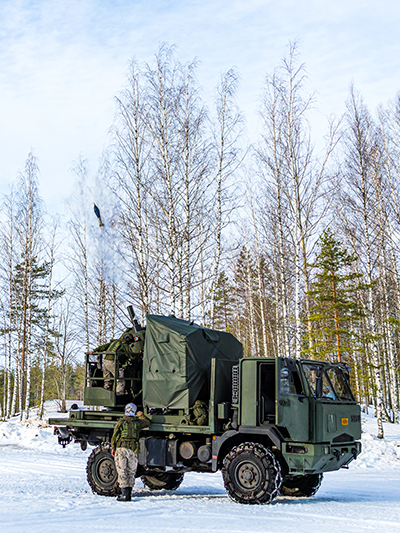
The infantry still has a key role to play on the battlefield. Although the range of instruments for effects projection has diversified, and long-range weapon systems can deliver effects far beyond the contact line, the infantry still remains central in area control. It is difficult to control areas without forces in control of these areas. In other words, contact lines or defence layers cannot be controlled without the infantry.
New technologies may force a change of mindset towards somewhat reconsidering the infantry’s use on the battlefield. It may well be that on the battlefield the most drastic battle damage and casualties are now caused by employment of long-range weapon systems including various types of drones. But seizing contested sectors and consolidating control over them will continue to require land forces. Who fixes the adversary infantry and its fighting vehicles and consolidates control of areas if it is not the infantry? So, let’s give shaping fires and other enabling effects the opportunity to have more responsibility for disruption. But let’s also make sure that the maneuvering infantry is competent and capable of operating where decisive action on area control is executed.
Commandant of the Infantry School Lieutenant Colonel Markku Saarelainen


